Wednesday, January 30, 2013

Major training for Asian peacemakers--November 2012

Training participants in front of the Chiang Mai YMCA
 In November 2012 we gathered 25 peacemakers from across Asia for a Training of Conflict Transformation Trainers held at the YMCA in Chiang Mai, Thailand.  We had people from 8 countries:  India, Thailand, Myanmar/Burma, Indonesia, the Philippines, South Korea, Hong Kong, and Kyrgyzstan.  Some were educators teaching peace studies, some were grassroots activists, some human rights activists, some pastors, some church executives, and some missionaries.  We had various Christians and one Hindu in the group.


A "people sculpture" about peace
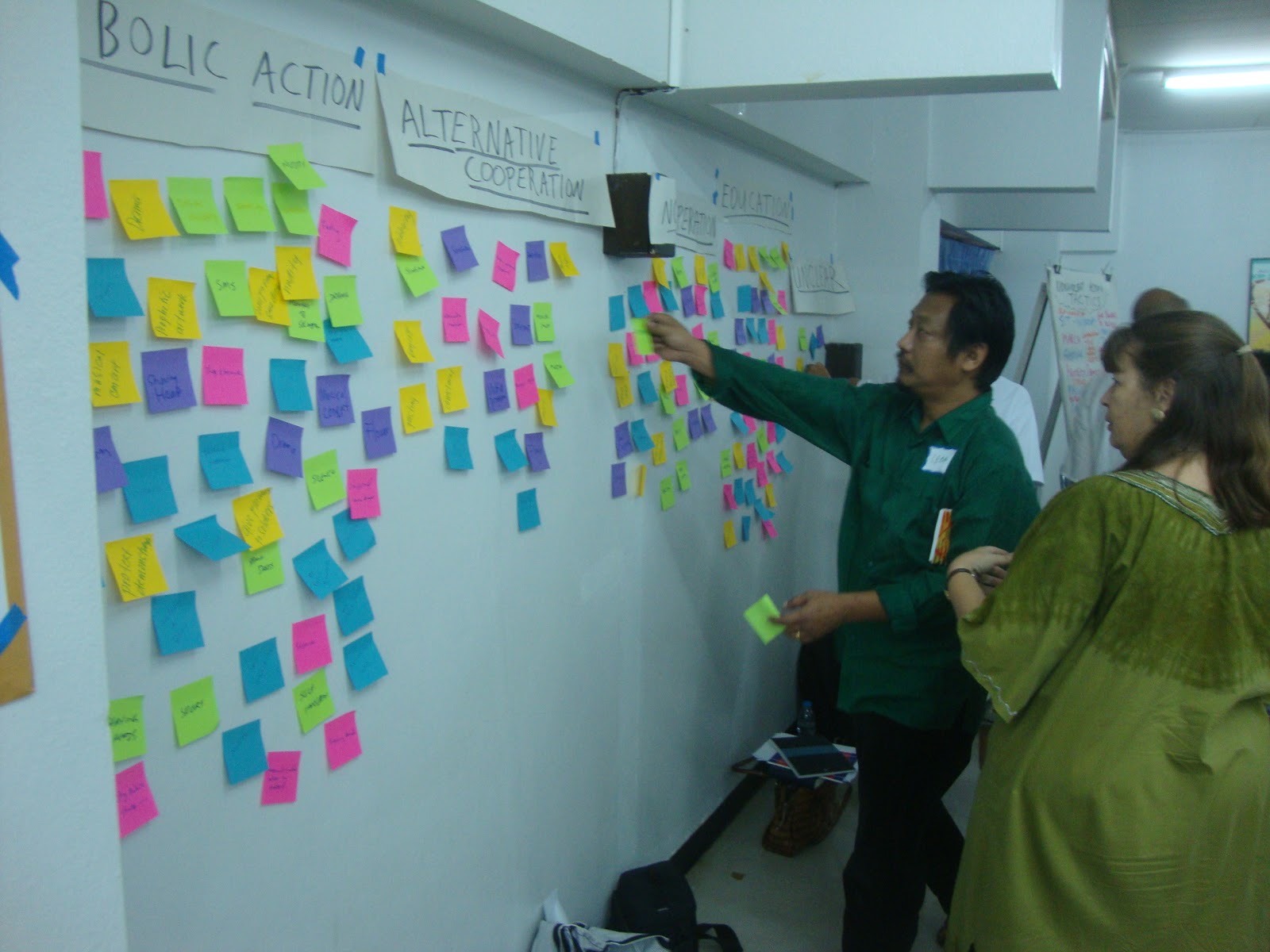
Exploring different types of nonviolent action
Together utilizing experiential education methodologies and often Bible studies we explored the topics of conflict analysis, personal conflict styles, conflict resolution, mediation, dealing with diversity in conflict (mainstream and margins), power dynamics, nonviolence, developing campaigns and strategies for change, trauma healing, reconciliation, the principles and tools of experiential education, and spirituality to sustain oneself for the long haul.


The "elephant game" exercise was particularly challenging!
In the "mattress exercise" participants had intense discussions about strategies to undo aspects of oppression
The training was very intense, some days going from 9 in the morning to 9 at night.  But we could deal with the intensity because of the variety of tools, experiential exercises, high energy engagement by the participants, and a passion to take something of great value back into the conflicts at home.

Legacy of the Children of Abraham

Christians and Muslims—how should we relate to each other?  Through violent competition, through conversion efforts, through keeping our distance, through loving our neighbors, through working together for peace?  All these options have been exercised by Christians and by Muslims.  Both religions, along with Judaism, trace their spiritual roots back to Abraham, but the relationships of these religious siblings has been highly conflicted over the centuries.

Five years ago 130 Muslim scholars from various Muslim traditions from around the world issued an open letter to the heads of global Christians communions, including the Vatican, Orthodox Patriarchs, the Archbishop of Canterbury, and the Baptist World Alliance.  The letter was titled from a phrase in the Qur’an, “A Common Word between Us and You.”  In the letter these Muslim scholars set forth two things that Christians and Muslims have in common:  Calling people to love God and to love our neighbors.  The Muslim scholars asserted that these two calls can be the basis for how the two largest religious bodies in the world relate to one another.  Various Christian communities formally responded to the Common Word document including the Baptist World Alliance.  These documents can all be found on-line at http;//www.acommonword.org. 

In Boston this November 30th through December 2nd Muslim and Baptist leaders from North America gathered for the second Muslim/Baptist Dialog based on the Common Word document and responses.  Papers were shared and responses given in plenary sessions and small groups.  I gave the final presentation, trying to bring the matter of how we relate into the practical areas of conflicts we face and how we will live together in diverse societies.  (If you want a copy of what I presented, send me an e-mail!)

Two days later I was landing in Abuja in northern Nigeria as part of a Baptist World Alliance human rights delegation invited by the Nigerian Baptist Convention.  For the last decade Northern Nigeria has been the scene of inter-religious violence between Christians and Muslims in which many churches and mosques have been burned and people killed from both religious communities.  But in the last couple years this conflict has taken a vicious turn through the appearance of an Islamist extremist group popularly called Boko Haram.  Boko Haram has engaged in a campaign of bombings and assassinations, targeting government officials, the military, the police, the United Nations, and churches.  Churches, including many Baptist churches have been bombed or fired upon, often during worship services.  Many people have lost their lives and many churches have been destroyed.
Praying in the ruins of a bombed church in Jos

Our delegation visited the sites of destroyed churches in the cities of Kaduna, Jos, and Kafanchar.  We listened to pastors and other church leaders tell of the attacks, the loss of members, and the difficulties of trying to rebuild.  We expressed our solidarity in Christ with them, praying together amid the rubble.  The Bible tells us in Romans to “weep with those who weep.”  We wept with our sisters and brothers.

Imam Muhammad Ashafa speaks as Rev. James Wuye looks on
But what should we do?  Some Christians have responded to violence with violence.  Others have responded by trying to work for peace.  We also met Muslims trying to work for peace.  One inspiring moment for me was meeting Muhammad Ashafa and James Wuye, an imam and pastor who both participated as leaders in the violence in Kaduna until they began an amazing journey of reconciliation (told in my book Interfaith Heroes 2).   As a result of their inter-religious reconciliation work they have been nominated for the Nobel Peace Prize.  We also had Muslims present at the two-day conference and training on conflict transformation we held in the Nigerian capital Abuja.  I led three workshop sessions on dealing with conflict nonviolently.

Nigeria is a pivotal state in Africa, the most populous country on the continent and a key leader in many diplomatic and peacekeeping efforts.  The Nigerian Baptist Convention has over 6 million members and 10,000 churches.  How the Nigerians deal with the challenges of Muslim-Christian relations is critical not just for the viability of their nation but also for inter-religious relationships in Africa as a whole and the rest of the world.

There are many views among Christians about how we should relate to Muslims.  I believe we must begin with the same call made by the Muslim scholars in the Common Word, loving God and loving our neighbor.  I also believe we as Christians are called to share the good news of Jesus Christ with everyone we can, but if we include hatred, suspicion, ignorance and violence in our approach we will not be bearing a good witness to the love of God.  We would also be unfaithful to some of the clearest and most concise the teachings of Jesus, who doesn’t even allow violence against us as an excuse not to love.

There are no easy solutions in Nigeria, but there are people including some courageous Christians and courageous Muslims, trying to find the way forward.  It was a privilege to come along side them for a while and to share the struggle together.

Kenya Trip--June 2012

In June 2012 I traveled to Kenya for a couple weeks of peacemaking training.  I was working primarily with Wilson Gathungu, my friend from an earlier trip, then later with Pini Kadulah.

The peace procession begins on the dividing highway
Wilson took me to Mauche, a village in one of the hot zones during the 2007-2008 post-election violence.  Pastor Kones from a Pentecostal church in Mauche had been a participant in our June 2011 Molo District training, and now he was hosting the training for his village and people from some of the surrounding villages.  The highway had become a dividing line between the Kikuyu and Kalenjin communities.  But we brought together people from those communities as well as some other ethnic groups.  For two days we trained on conflict resolution and building alliances for peace and reconciliation.  We concluded on Sunday with a march down that dividing road, ending with a rally in downtown Mauche.  Wilson had written a couple peace songs that he taught everyone.  They even got me dancing to them at the rally!


Then Wilson and I drove up north to the Pokot district where Pini had pulled together a 3-day training for us to lead.  The Pokots are involved in violent conflicts with their neighbors, often around the issue of cattle rustling.  We had an excellent workshop at the New Vision Baptist Church.

The high point was after we had done a Bible study on 2 Samuel 21 and the traumatized mother Rizpah who lost her two sons to violence and transformed the situation through her nonviolent public action.  So I asked them to apply what we were learning about trauma healing to the context of cattle rustling.  Young Pokot men have to have 30 or so cattle to give to a bride's family in order to get married, but almost nobody has that many cattle.  So they have to steal the cattle, and everyone is armed with AK-47s.  When someone is killed often their bodies are just left in the bush; there is no grief expressed, no retrieval or burial of the body.  People go on as if the young man never existed.

Wilson facilitates part of the workshop in Pokot


I asked them to name a fictional young man, which they did:  Noroko, "Warrior."  I asked what would we do when Noroko died.  Participants talked about whether Noroko had been justly or unjustly killed, determining whether they should ignore his body or engage in a revenge raid against his killers.  As the discussion went on I realized only men were speaking.  I asked if any women would like to speak, and a woman chief spoke out (yes, I met a few women chiefs on this trip) saying the same thing as the men.  I was getting nowhere, so I put an empty chair at center stage and said this was Noroko's mother--what would she say to us.  A woman came forward and sat in the chair, catching me by surprise.  She took the part of Noroko's mother and spoke of her grief and sadness that more would die over her son's death.  Her feelings had been unacknowledged in the culture, but she gave them powerful voice.  I challenged them that these were not my words or my expression, but an expression from a part of Pokot culture that was being silenced and marginalized.  She asked for ways to recognize his death and her loss.  Pini then brought out the matter of planting trees to remember those who had died in a way that would bring healing to the people and the land.  The next day we planted trees around the church and in the community to honor those who had died.

Boaz (in white) speaks to folks at Turkhana village
On Saturday, a young peacemaker named Boaz invited us to visit a distant village called Turkwell where Pokots had been in violent conflict with a neighboring Turkhana village.  It took us almost 3 hours to get to the village, which was way off the road and through the bush.  A pastor of one of the two churches in the village had been at our workshop.  When we arrived the men of the village were also sitting and squatting in a large circle with the women and children clustered around.  Wilson, Pini, Boaz and I all spoke about making peace, but one elder spoke comparing their enemies to a virus that must be wiped out!  It was quite a challenging dialog, but I particularly enjoyed watching the patient firmness with which Boaz handled the situation.  He was young but had a depth of wisdom and insight into the situation that enabled him to be an amazing peacemaker.

Saturday, January 14, 2012

Mindanao, Philippines--Sept. 2011

At the end of a long training trip in the Philippines I headed to Davao City, Mindanao with three of the staff from the Convention of Philippine Baptist Churches (CPBC). We were scheduled for a 3-day training on interfaith peacemaking.

Mindanao has been the hottest place in the Philippines in terms of violent conflict. The majority of southern Filipinos are Muslims, concentrated on the islands of Mindanao and Sulu. A major ethnic group among the Muslims are the Moros. For decades the Moro National Liberation Front (MNLF) has been fighting for independence, but has in recent years established a cease-fire with the government. Meanwhile an Islamist group spun off from the MNLF, calling themselves the Moro Islamic Liberation Front (MILF). The MILF has been in recent peace talks with the government of the Philippines, but those recently broke off. There's also a small more extreme group called Abu Sayyef. Alongside that conflict is another decades-old conflict with the New Peoples Army (NPA), a Communist insurgency that had declined following the 1986 People Power movement that ended the Marcos dictatorship. But the growing economic disparities and desperation of the poor have brought new life to the NPA insurgency.

So we were intending to focus on interfaith relationships as one particular peacemaking component. I'd hoped to have a more equal participation of Christians and Muslims, but that wasn't what developed. We had a large group of Baptists, one Pentecostal, and one Muslim. The Muslim was a young imam named Karem from a nearby mosque who could only be with us the first day. So I knew I'd have to be flexible in my workshop design to make the most of the situation which presented itself to me as a trainer.

The first day we dealt with more of the theory of conflict transformation that was most relevant to the situation in Mindanao. We covered getting to win/win solutions with a special emphasis on identity conflicts. We also did a lot of work on mainstream/margins. The imam was an excellent participant, not being intimidated by being the only Muslim in the group (definitely margin in this group!). He had a deep commitment to peace and broke a lot of stereo-types that the Christians in the group had.

The second day we focused on interfaith relationships. But we were all Christians since Karem had to conduct exams at the Islamic school at his mosque. We began with a little exercise called "The Big Wind Blows" that is kind of like musical chairs (without removing an additional chair each round). I said, "The Big Wind Blows for everyone who has been inside a mosque." Only one person had! These are the leaders and peace people in a conflict area where Christian/Muslim relationships are one of the key fault lines. So I knew we had to change that right then and there.

I asked the pastor who had invited Karem (and was the only one who had been in a mosque) if he could arrange for us to visit Karem's mosque later in the day. Meanwhile we worked on a number of interfaith relationship issues. We also exercised our curiosity about Muslims and constructed a list of questions the group had.

At about 2:30 we walked from our retreat center to the mosque (we'd been able to hear the calls to prayer throughout our time at the center). Karem greeted us warmly. We were given a tour of the school, spending time with short discussions in various classes. We discovered that half the teachers were Christians, though all the students were from Muslim families. We met with some of the leadership in the school to ask our questions about Islam and the various practices of their faith.

At the time for prayers we went into the mosque for, the men in the main hall, the women in a smaller area partitioned off in the back. We observed the prayers. Then we talked a bit more with Karem about the prayer time before heading back to the retreat center to debrief our experience. I closed saying, "The Big Wind Blows for everyone who has been to a mosque!" Everyone laughed and cheered.

We closed out the workshop on the third day looking at various strategies for building relationships for peacemaking work and how to move people with varying degrees of support or opposition to the issues that concern us. Participants worked on specific plans for their return home, including dealing with disagreement within their own Christian communities about even entering into positive relationships with Muslims (a challenge in many U.S. congregations, too!). The participants all left feeling very positive about what we had achieved. Afterward I talked further with the CPBC staff about next steps in peacemaking and training, both training that would involve me and things they could do on their own.

Building Bridges in Manipur, India--July, 2011

Manipur is the state with the highest killing rate in India. Meiteis, Kukis and Nagas struggle with different political concerns, religions and living contexts. There are multiple insurgent groups and civil society groups that join heartily in the conflicts. I've been there a lot, initially working on Naga reconciliation efforts. Now I'm expanding to deal with the larger circle of conflict. I've been especially excited to connect with a new peacemaking network called the Peace Dialog Initiative (PDI). PDI is a network of Meiteis, Kukis and Nagas chaired by Deben Sharma, a delightful kindred spirit.

We met for two days in Imphal at the Krishna Consciousness Center. The first day was spent in making position statements with spokespeople from each of the conflicted ethnic groups. Then there were responses from each group. At the end of the day it would be easy to despair because positions were hard and fast and totally opposite. Because the issues had to do with identity the problems weren't solvable by finding a meeting point halfway.

I was given the responsibility of facilitating Day 2, trying to help participants find a way forward and conclude with some sense of hope. I began with a few educational pieces to help participants reframe the way they were looking at the conflict as defined by the position statements the day before. We tried to think "outside the box" those positions created and brainstorm in dialog with one another. The brainstorm was begun in pairs from different ethnic groups coming up with ideas for specific steps forward and picking the three best. Then the pairs formed fours, shared their ideas and picked the best three ideas. Then we made eights and picked the best three ideas. I gathered the refined list and grouped them into 6 categories. Then we had participants cluster around the category that most interested them. The new groups then worked up specific plans to turn the ideas into substantive programs the participating organizations could carry out.

After feeling frustrated and hopeless at the end of Day 1, the PDI participants finished Day 2 excited and with a specific work plan to advance peace and understanding in Manipur. We ended with an appreciation line including many hugs. There's still a long, long way to go in Manipur, but a key step in the journey is to give birth to hope for the people who will create the peace imperative.

Kenya--June, 2011

In June I was invited to Kenya by Wilson Gathungu and a team from Central Baptist Theological Seminary in Kansas City where Wilson has been a student. In a class with Terry Rosell on Christian ethics Wilson wrote about the political violence in December 2007 and January 2008 around the national election. Rosell challenged Wilson that what he wrote shouldn't just be a paper but a project. Wilson in response established the Kenya Peace Iniative, a project that took him back home to do the organizing work for a major effort at conflict transformation training and grassroots reconciliation activities.

Terry's wife Ruth is also a professor at CBTS, and she grew up as a missionary kid in Kenya and Tanzania. Terry and Ruth and their four adult children took on the KPI as a personal concern, helping to raise the funds and go to Kenya to participate in the project. One of their children, Nehemiah Rosell, participated in an 11-day training I led in January 2010 to train people to do the kind of training I do. In additional my wife Sharon joined the team. We ended up with Sharon, Nehemiah and I as the training team with Terry and Ruth providing devotional leadership.

Meanwhile Wilson was doing some of the best organizing work I've ever seen. He pulled together a large planning team that drew from the two major conflicted ethnic groups as well as two other groups. Church leaders from various Christian denominations got excited about the training as well as many university students and leaders from various social and political sectors. Wilson used the planning process to draw many people from communities throughout the Molo District into the initiative. Then he worked out follow-up plans that built naturally on what we were doing. He did fantastic work in both design of the project and in the hard nitty-gritty work of contacting and organizing people.

There were 5 days of the centerpiece project our team led alongside Wilson. The first day was hands-on reconciliation work with the 50 participants from the various ethnic groups and organizations. We went to one of the IDP (Internally Displaced Persons) camps. Then we built two homes--one for a Kikuyu family and one for a Kalenjin family, with Kikuyus, Kalenjins and others working side-by-side. I helped in hoisting up the roof beams. Sharon took off her shoes and jumped into the hole in the center of the house where mud was made with foot power to then plaster the walls.

Later in the afternoon we went to a school that was near one of the hottest spots in the violence. We planted a "peace forest"--over 50 trees with students of various ethnic groups joining our mixed peace workshop participants in planting the trees as a sign of peace. Then we all ate "out of one pot" from the different ethnic dishes.

For three days Sharon, Nehemiah and I facilitated a conflict transformation training. We covered topics of conflict resolution, nonviolence, trauma healing and reconciliation. We utilized many simulation games and other participatory activities. People commented about how there had been many structured dialogs by various groups to try to build peace, but they had never learned so much as at this training. That's the value of experiential education!

On Sunday our team went to a Kalenjin church only a few yards away from a Kikuyu IDP camp. Wilson had organized the people from the church and the camp to get to meet each other. They joined together in worship with Wilson preaching on reconciliation. Then people from all the various churches and communities in Molo District gathered in Molo Town. We had a big march with the Salvation Army band leading the way. We headed toward the soccer stadium for a peace rally.

Just as we came on the road to the stadium the skies opened with a torrential downpour that lasted almost an hour. We were all soaked and huddled under the only shelter in the area which was too small for us all. Pastor Grace, who had been in the workshop, praised God for the rain (we were on the edge of the drought area that was to make awful news in Somalia and parts of Kenya a few weeks later). She led the band out into the mud, celebrating. I would have called the rally off, but people aren't so easily discouraged in Africa! When the rains stopped everyone gathered by the soaked stage. The music started, and they did the whole program. I was the main speaker, preaching on Romans 12.21, "Do not be overcome by evil, but overcome evil with good." Since nobody else shortened what they did, I didn't cut it short either. We had a great time closing out an amazing chapter in the journey toward reconciliation in Kenya.

Wilson has continued building on what we started. We regularly connect with and consult with participants from the workshop. I'll be returning in June 2012 before the next election to continue to build on the work Wilson and others have been doing.

Friday, April 1, 2011

From an undisclosed place and time--#2

We traveled to another city, and on Monday we began another training. We had about 30-35 participants from many different ethnic groups. Again I worked mainly with the mainstream/margin concept, and got some of the best and most intense stuff ever from this group, serious and fun at the same time. Then we did studies on Acts 6 and Esther 4. I finished with some very specific peacemaking ideas for their context, using the image of drying the tears of Jesus.

One of our hosts closed out the day with a feedback session that was very moving. One man told about how he has felt so bitter and angry with people from the dominant religion over some of the hardships he'd experienced. He said he even hates to see people in that traditional religious garb. But he realized that he is in direct contradiction to the teaching of Jesus, and he felt a huge release and washing of forgiveness toward those from the other faith in our sessions. I was almost in tears as I listened to him. Then others spoke about ways their thinking has been stretched in exciting and tangible ways. They were very specific, talking about drying the tears of Jesus and not being limited by their marginal positions in society.

On Tuesday we continued dealing with the story of Rizpah and trauma. Later in the feedback session one man said he rated the workshop as a 10 on a scale of 10: "This was the answer of God to our situation." We dealt with some specific problems in which they had experienced heart-rending conflict. We helped them strategize about creative and transformative ways to address those situations.

The next day we had another intense session meeting with top religious leaders from minority communities. We explored the problems and ways to develop new alliances to address those problems.

Whew! It's been an intense trip, and far more productive than I'd ever dreamed. We might be able to find some ways to build on the openness we experienced to make a regional impact for peace. Plans are underway for follow-up activities.

From an undisclosed place and time--#1

I'm writing from a place I need to keep undisclosed and at a time I'll not specify.

A friend and I were greeted by our local hosts, and we quickly traveled to a community that had been torn apart by a terrible outbreak of ethnic violence in which vigilante gangs of men from one ethnic group systematically attacked communities of a rival ethnic group in the city while the police and army did nothing. The death toll was horrifically high, and many thousands of people were displaced.

A local pastor took us on a tour of the two major neighborhoods which were targeted in the "war" (the pastor's term). Huge stretches of houses were burned and demolished. The destroyed neighborhoods had been fairly prosperous. Now many people live in UN tents inside their old compounds or small one-room homes. Some places are completely abandoned. Many UN agencies are working here; we saw a massive World Food Programme storage facility at the city airport to assist the displaced people along with the UN High Commissioner for Refugees tents.

The pastor, who is not from the targeted ethnic group, took us to visit some personal friends who are from that group. We talked to two adult sisters. They had hidden in their basement, a small dirt cellar, but their house was burned down around them. The mother and uncle were killed, but the sisters got out. One sister was then caught outside and was severely injured on the head. Her attackers left her for dead in the street. The sisters showed us the hole in the ground with charred debris where their mother died. They showed us documents and photos of their loved ones. They could only gather their mother's bones recently, months after the attack. Piles of bones had been left in the morgue unidentified and all mixed together. I asked if I could pray for them, then I did using phrases about God's compassion and mercy that echoed with their own religious traditonal prayer phrases.

On Friday we began the training. My colleague made a presentation about peace. Then I got into the dynamics of group difference and mainstreams and margins. We have people from many different ethnic groups in the training. They are all pastors or church leaders. There is a lot of energy in the group and a high percentage of people participated in the discussions.

Saturday we continued, focusing on the story of Rizpah in 2 Samuel 21. Once again this proved to be a story that unlocked so much for the participants. We unpacked the dynamics of becoming a victim of trauma, the ways some victims become aggressors creating new violence, then they process of breaking out of these destructive cycles and moving toward healing and reconciliation. Later as we were doing some small group brainstorming about practical ways pastors and church leaders and student ministry leaders can apply what we'd been working on for the two days, I was deeply moved when participants from the dominant group came up with some concrete ideas related to justice for the group victimized by the violence. They demonstrated the mainstream listening to the cries from the margins in a very contextual way, which let me know they were getting what I'd been teaching about.

From northeast India #3--November 2010

I rode with Leban Serto on the drive down from the high hills of Shillong to the airport in Guwahati. When we boarded the aircraft I discovered by International Ministries colleague Debbie Mullinex on board. Turned out she was going to Imphal, too. Then talking with her I discovered she was coming to Imphal to help me get in! Manipur is under a form of martial law (India's Armed Forces Special Powers Act), so you have to get a "Protected Areas Permit" to enter the state. Foreigners traveling alone have a very difficult time getting in, so Debbie was asked to come as well so the two of us could be put on the PAP application. Debbie is a development worker serving in northeast India, especially helping connect volunteers to various opportunities in the region. So I found out that I had a friend along for the journey, though Debbie had plenty of work to do on her own while I facilitated the trainings.

The first training was a two-day event with the Baptist association leaders. There is a core of very committed Baptist peacemakers working with the Manipur Baptist Convention's General Secretary Vumthang Sitlhou. I was very impressed with their vision and how they were making progress step by step along the way to give some substance to that vision. Manipur has the highest killing rate of any state in India. There are many insurgent groups, countered by the Indian army and state paramilitary forces. There is a movement of resistance in Manipur against India rule as well as conflict between various groups including inter-tribal violence. The Baptists bridge a lot of these divisions, so they have a special opportunity for peacemaking.

We had a broad-ranging training, and participants especially appreciated digging into the Biblical teaching related to the various conflict transformation themes. We explored stories such as the conflict in Acts 6 which saw the church grow through constructively handling their inter-ethnic conflict and Esther 4 when the margins mobilized to overcome a genocidal policy. We dealt with the teachings of Jesus in the Sermon on the Mount (turning the other cheek, giving the coat, going the second mile) as well as the nonviolent transformative action of Rizpah in 2 Samuel 21.

Then today (Saturday) some of the Baptist leaders, especially the leading peacemaking team, were joined by an interfaith community called the United Religions Initiative--Manipur Chapter. We had some Hindu leaders, Bahais, a Muslim leader and two leaders of traditional tribal religions. Together we engaged in extensive discussions, and I gave a training segment on getting to win/win solutions, especially with a twist about identity conflicts, of which there are many in Manipur. I gave copies of Interfaith Heroes (1 & 2) to the URI leaders to share among the group members. It was good to see this group together. They aren't just meeting for dialogue and relationship building. They worked to mediate an end to a crisis this spring where Nagas and the state forces clashed ending with two students dead and an economic blockade imposed by angry Nagas blocking the main highway into Imphal. They have also helped negotiate the release of people kidnapped by insurgent groups. So these are interfaith activists making a great team to try to turn the tide in the conflicts in the region.

Tomorrow I will preach in a Rongmei Naga Baptist church on the text of Psalm 85, especially verse 10 which speaks of Truth and Mercy coming together and Justice and Peace embracing. I call it "A Recipe for Reconciliation." Then I head to the airport and start the long trip back home, flying into Delhi and catching the 2 am flight to Frankfurt and then Detroit.

Whew! It's been a full trip with lots of training and interaction. I'm encouraged to see so many rising peacemakers in this volatile region. The investment in peacemaking here and the determination of so many folks to learn the principles and skills of peacemaking is paying off with a broader constituency for peace and a high caliber of leaders. It takes a while to build up such a movement. We've seen the impact in how the civil society groups, including the churches, have played such a powerful role in the Naga reconciliation process. Interfaith partnership will be critical for broadening this impact.

From northeast India #2--November 2010

I've been part of a three-day consortium at the Martin Luther Christian University in Shillong. Leban Serto is the coordinator of the Peace Studies Program at MLCU and the one who invited me to be a resource person. In the mornings we had plenary programs. On the last day I was the main speaker, talking on interfaith dimensions of peacemaking. I shared stories from Nigeria and Lebanon as well as from our interfaith work in Detroit. I also sketched the interfaith family tree on nonviolence (which has some arbitrary dimensions to it admittedly): From Leo Tolstoy to Mahatma Gandhi to Abdul Gaffar Khan to E. Stanley Jones to Martin Luther King Jr to Abraham Joshua Heschel to Aung San Suu Kyi. (That's not always linear, but they are all connected.) Besides Christians at the consortium we had Hindus, Buddhists, practitioners of indigenous religions, a Jew, and some people of no specific faith. I'm not aware of any Muslim participants.

Then each day in the afternoons I led a workshop on conflict transformation with special elements on peace education and interfaith relationships. We explored dynamics, processes and skills of conflict transformation, mainstream/margin, and using a tool for analysis that moves to building comprehensive strategies. The energy levels were very high with a lot of interaction. I was delighted to meet some Baptists who are deeply engaged in peacemaking work in the region, especially some women activists who have had extensive training. We also had a number of students from Burma, both Christian and Buddhist, who participated in the training. Toward the end of one of the sessions we had some wonderfully blunt and exciting discussions about applying these things to the resistance against the Burmese dictatorship as well as to the many armed conflicts in northeast India. It was a great group to work with.

In the evenings on the first and last night of the consortium we had some cultural programs with dance and music. Talk about a cultural feast. There are over 200 different ethnic groups in this region, with their own languages, dances, dress and customs.

Today I worked in a postscript training for Christian students and graduates of the peace studies program. We went back over the material we'd covered in the consortium workshops laying some Biblical studies addressing those same themes. We looked at Acts 6.1-7 through the lenses of first mainstream/margin and then conflict resolution to a win/win solution. Then we plunged into Esther 4, first with mainstream/margin analysis and then using a tool called either "Social Barometer" or "Spectrum of Allies"--a great tool to work on understanding the different types of people related to an issue and developing complex strategies to move people in your direction.

In the afternoon I was taken to a "sacred grove" for the Khasi people--a huge forested area that is kept as a natural preserve. Along the edge there are many ancient stones placed in various configurations kind of like miniature Stonehenges. Nobody knows who the people are that placed these stones or what their purpose was, but they are scattered throughout the Meghalaya region. Most were rather small, some were about 6 or 8 feet high, and then there were two that were about 12 to 15 feet high. My friend tells me that legend has it that these stones were not raised by human hands but by prayer.

From northeast India #1--November 2010

The northeast of India is the site of many ethnic insurgencies. So peacemaking and conflict transformation are key concerns. Over the years a lot of peacemaking efforts have been invested here. I've worked in the region for over 14 years, mostly with the Nagas, but also touching on some of the other conflicts.

I was invited to be the major resource person for a 3-day peace consortium at the Martin Luther Christian University. MLCU is relatively new, only four years old, and is an ecumenical university. It already has about 1,700 students with a major peace studies program. Dr. Leban Serto directs the program, and I met him when I was last in northeast India in December 2009.

The trip was long--flights from Detroit to Frankfurt to Mumbai (Bombay) to Kolkata (Calcutta) to Guwahati. Then we drove for about three hours up into the hills of the state of Meghalay to Shillong. I left Detroit Sunday evening and arrived in Shillong on Tuesday evening with only a few hours sleep.

Shillong used to be the administrative center for the entire northeast of India during the British colonial days. The city is a bit more developed and grander than the other cities in the region. Being up in the hills the climate is much cooler than in the plains. So I'm wearing a sweater and a jacket most of the time. Shillong is a learning center for the region. It also is the headquarters for the India armed forces, facing both China and Bangladesh as well as dealing with the multiple insurgencies.

The first two days here were spent in recovering from jet lag, planning and coordinating about the consortium, and doing a little sight-seeing. Then the training started today. We are taking a day before and a day after the consortium for special programs for students and graduates of the peace studies program. So I'll be training for a total of 5 days. The consortium is an interfaith event, so with the students I'm doing a special focus on the Biblical material related to the topics we'll be dealing with in the consortium workshops.

Today we got off to a good start. We have participants from across northeast India and from many of the ethnic groups. We also have two Mizos from Bangladesh, a Hungarian woman and a South Korean man. We did some introductory material related to conflict transformation. Then later I facilitated the styles of conflict section using the "conflict animals"--which some of you have seen me lead.

So hopefully a good night sleep, then tomorrow we have a bigger group of people from different religions and even different parts of India than just the northeast. Actually, a good night sleep will be a miracle. Today is Diwali, the major Hindu festival of light. So people have already been setting off firecrackers over the past few days, but I've been warned that tonight it will be almost non-stop. The firecrackers here are much louder than in the U.S., sounding more like bombs, and I'm not talking about cherry bombs. It literally sounds like a war going on out here. So I'll have jet lag and firecracker lag most likely!

From Zimbabwe #3--Sept. 2010

Numbers tell the story in this edition of the Zimbabwe trip notes:

3--Gweru was the third city for conflict transformation training after the training programs in the capital Harare and the second-largest city Bulawayo. Gweru is a much smaller city, but it is in the center of the country close to the center of the national highway running between Harare and Bulawayo. The offices of the Convention of Zimbabwe Baptist Churches are located there, and the Zimbabwe Baptist Theological Seminary is about 24 kilometers outside the city. We were in the heart of Baptist life, which in this case was very problematic. There are major divisions and conflicts within the convention that spilled over into the program in which I was involved, and those problems became evident at the Gweru trainings.

100--We had a long day of intensive training with the 100 or so students of the seminary. Dr. Henry Mugabe, the principal of the seminary, is a visionary educator and dedicated peacemaker. He's built up the seminary over the past 18 years to a large sprawling facility with a significant student body. There are a lot of women students, many who want to become pastors, and there is an ordained Baptist woman teaching theology. The school also has students from other denominations--Anglican, Lutheran, Pentecostal and Zionist (an indigenous African denomination), thanks to the seminary's growing reputation for the quality of their education. But some in the convention don't like the seminary's views on women, ecumenical relationships and African-rooted theology, so there is a major movement against the current seminary leadership and an effort to seize control from the governing board. Conflict in the church? Why am I not surprised? But I was saddened to see some of the power politics and outright threats that were going on. Dr. Mugabe and the seminary need our prayers.

The workshop with the students started slow, as experiential exercises with a large group who aren't used to such learning can demand a lot from the facilitator. But we eventually got them going. By the end as we were working on the Sermon on the Mount and Transforming Initiatives the energy was very high. The response was so positive that they arranged for me to do an unscheduled late afternoon training related to transformative leadership the next day. That time we didn't need to worry about the energy as they were fully into the flow of the participatory style.

6--The main workshop, however, over the next 2 1/2 days only had 6 participants, a shocking decline from the good-sized sessions we'd had everywhere else. We learned that some pastors had received warnings that the police would arrest people who participated. Those warnings didn't come from the police, who actually had representatives at the workshops in Bulawayo and Gweru in a very positive and interactive way. The threats came from Baptist leaders who were not in control of the project! I never got names of those who were causing the problems, but it was clear that the internal conflicts were upsetting the organizers and some of the participants. They were embarrassed that such a good program (that could help those involved in the conflict on all sides!) was being targeted in such a way.

We went ahead anyway with the training with a few others along the way who would come and go. 6 is a number of quantity, but as for quality we had some of the top leaders in the convention's youth department and a wonderful young clergy couple recently graduated from the seminary. Investing oneself in key young leaders is never a waste!

2--The highlight for me wasn't any of the trainings in Zimbabwe, though we had some great times. The highlight was spending 2 weeks with 2 emerging leaders who have a great passion for peace flowing out of their great passion for Christ. Philip Mdzidzi is the Director of the Youth Department for the convention, and his vision about raising up a generation of Baptists committed to Christian peacemaking in their context and with the skills to make an impact has been the driving force in the program. He saw us laying the foundation across the country with this trip and the trainings, but also envisions local networks with an annual gathering to share stories, learn skills and encourage one another. Lancelot Muteyo is in his early 20s and is already a dynamo. He directs the Distance Adoption Program (a form of child sponsorship) between the Zimbawean convention and the Italian Baptist Union. He's also a passionate peace activist who was one of the youth leaders at the Global Baptist Peace Conference in Rome last year.

The three of us--Philip, Lance and I--traveled the length of Zimbabwe in the car (we finally got it fixed in Bulawayo!). During the long drives and around the tables where we ate we had the deepest training and conversations. It was a mobile training of trainers program as we shared stories and experiences. Lance especially went through much of the material 4 times over the course of the trip. He led some of the transition activities and energizer games, but then I began to incorporate him into leading some of the content pieces. He jumped in with flair and skill, playing an announcer for ZBC (Zimbabwe Broadcasting Corp.) interviewing Paul and Barnabas about their conflict over taking John Mark on a missionary trip (see Acts 15.36-41 for the story). When he joined me in the leadership of the Village Game he was delightfully slick and nasty (that's the role). Afterward we discussed the trainings and talked about ways to adapt or meet various challenges that can emerge in different groups.

There was much else to share that I'll gloss over--the involvement of Brickson Sam from Sierra Leone (also a Rome conference participant--had a little reunion with 4 of us including Chiromo) teaching on tribalism and conflict, the mosquito nets distribution that Brickson was doing with the help of the Youth Department through His Nets, cooking breakfast over a fire because of no electricity, singing about sadza and sauce with Philip, giving Lance astronomy lessons under the incredible night sky, hauling a paper mache lion around that was a gift from a craftsman in one church, meeting with the General Secretary of the Zimbabwe Council of Churches to discuss possible ecumenical work in the future, and the great difficulty getting internet access. A full trip to say the least!

From Zimbabwe #2--Sept. 2010

So here's the second edition of the news from Zimbabwe, brought to you by the letter "A":

Anxious Automobile--as we departed from Harare for Bulawayo, about a 5 hour trip, we had many delays. One of the biggest was needing to get new tires for Philip Mdzidzi's car as one was flat when we got out of the training sessions in Harare. That tire was balder than me, and another one was no better. So with a long trip through lots of desolate area we knew we had to do something. With a few other delays we left Harare around 6 pm, still hoping to get to Bulawayo. But a couple hours into the trip we developed transmission trouble which finally came to a head with the car stopped late at night in the middle of an intersection in a town along the way. Fortunately, we were to pick someone up in that town, and they helped us limp into a 24-hour gas station. The transmission fluid was gone, so we filled up and took extra with us. For the rest of the journey we had to stop periodically to top off. We limped into Gweru, a little more than half way and the home for the Baptist Convention offices and the seminary, a little after midnight. In the morning we continued on to Bulawayo, stopping all along the way to keep pouring more fluid in for the transmission--obviously a serious leak going on, but we finally made it!

Another training--because of our delay in getting to Bulawayo, we had to shorten the training. But we had a good group. About 2/3 of the group was youth, the others older adults. The pastor of the host church was the student dean of the seminary. We had about a day and a half of training on conflict transformation and nonviolence. The church invited the police to come and be a part (a long and interesting story). Two women community officers came and talked about various crime issues. I had some interesting discussions with them and found out that they were developing community policing, pre-trial mediation and restorative justice practices--so that bodes well for the future of Zimbabwe. Meanwhile I had a great time especially with the youth, encouraging them, helping them find their voices, and stretching their horizons. On Sunday I preached at the host church (Ebenezer Baptist Church), and some folks from other churches who had attended the workshop came with the blessing of their pastors.

Antelope and other Animals--Sunday afternoon we got another late start for Victoria Falls (late starts are a constant theme here). That was about a 5 or 6 hour journey, and soon night fell. But along the way we saw antelope near the roads. I was dozing when a small herd of zebras crossed--bummer! We pulled into a cheap lodge (look up to see Motel 6!) around midnight. Then as we came into Victoria Falls the next day we saw lots of baboons, a sight we were to see a number of times on the trip back. Later when we got to Gweru and had some off time, Philip took us to a private game preserve. We went on a ride through the preserve seeing herds of impalas, water bucks, wildebeests (gnus), zebras (so I did finally get to see them) and giraffes. We saw elephants at a distance going down to a lake to drink. The park also has a special 500 acre enclosure to rescue lions from bad captivity situations or injuries and then raise cubs that can be returned to the wild. So we saw lions, but not out in the bush.

Awesome--Victoria Falls is one of the 7 natural wonders in the world as recently designated by the United Nations, and without a doubt it is awesome. It's the widest waterfall in the world, with the falls spanning 1.7 kilometers in a fairly straight line, broken by a couple islands, and plunging into a gorge at a height about twice that of Niagara Falls. It's the dry season, so the Zambesi River is lower (not it's lowest), still creating the awesome sight and sound that gives the falls its indigenous name that translates "Smoke that Thunders." Opposite the falls the mist creates a permanent rainfall and lush rain forest. We were soaked, but quickly dried off as we backed off from the falls. I rejoiced in the majestic work of the Creator--truly awesome!

Accident--on our way back from Victoria Falls, we were only 20 or 30 kilometers out of town when we came upon a typical poor country accident. A pick-up truck had been carrying a full load of passengers in the back, riding on bald tires like we once had. A tire blew out at high speed (maybe 90 to 100 kilometers per hour) and the truck flipped over slamming the unprotected passengers into the pavement. We were about the third or fourth vehicle to stop. One woman was seriously injured and needed to be moved by professionals. Many others had severe cuts and abrasions. We gave people water to wash their wounds. An ambulance had been called for, but the nearest hospital was about 45 minutes away. We took a woman with a bad head wound and a mother whose baby has a bloody scrap across its forehead, shoving everything into the "boot" so we could make room for them. Then we drove them off to the hospital in the next town (where they happened to reside as well). In a place like this everyone needs to work together in such a crisis. If there aren't Good Samaritans, there is little hope.

Also, we're now in Gweru. I'll tell about that in the next letter. I started this two days ago but computer problems at the Cyber Cafe prevented me from sending it.

From Zimbabwe #1--Sept. 2010

I arrived in Zimbabwe (after stops in Senegal and South Africa) on Sunday night. Monday I met with the organizers for the training trip here--Philip Mundzidzi, the director of the youth program for the Baptist Convention of Zimbabwe and C.H. Chiromo, a Baptist pastor and peace activist I first met in Nicaragua in 1992 at a global Baptist peace conference. Also, Lancelot Muteyo, a youth leader who was at the Rome conference last year with Chiromo, is involved in the leadership of this training program.

Already there have been major changes. Some of the resource people didn't come (one may join us later in another city), so basically I'm doing the major programming with some input at transitions and summaries with the rest of the leadership team. So on Tuesday and today (Wednesday) I've led intensive conflict transformation and nonviolence training. We have about 25 participants, including about half youth, about a quarter of the group are women. We have pastors and leaders from two of the four Baptist bodies in the country. For a special evening program on transformative leadership last night we had about 35 people including an Assembly of God pastor.

I'm loving working with the youth. That's the focus of the training, and we have some great young leaders in the group. At first they were a bit hesitant to jump into the participatory form of the training, but today the energy and creativity was incredible.

Zimbabwe has lots of political turmoil. There are also conflicts within the Baptist churches. So we're pursuing how to be engaged nonviolently in church and social transformation. One pastor told me, "This is electric!" Another said he was discovering things he had never thought about. During breaks and after sessions I can hear the conversations where people are processing the content with lots of excitement.

So it's going well. Tomorrow we wrap up here in the capital of Harare (in the north east). Then we travel south west to the city of Bulawayo to repeat the program. Philip and Lancelot will be the team with me. Along the way we're doing a lot of talking about facilitation as they want to continue doing this kind of work (actually, they are already working in teaching and training, but this training will help expand their tool box).

The weather is wonderful. It's spring here, so some of the trees are bursting out with blossoms. It's cool in the evening--sweater or jacket weather. In the day it's pleasantly warm but not hot. Not sure if it will be this way across the country or just here in Harare which they say is at a higher elevation than the other cities.

Thanks for your prayers. I'll share more if possible. Internet access is a challenge.

Peace,
Dan

Monday, July 13, 2009

Naga Covenant of Reconciliation Signed


This June all of the top leaders of the Naga insurgent factions have signed a “Covenant of Reconciliation.” For over thirty years these groups have split Naga society, and the warfare between the factions has left thousands of Nagas dead and deep divisions within the Naga people. In 2008 a process of reconciliation was launched that brought people from the factions face-to-face, developing momentum that couldn’t even be halted by violent outbursts. Thanks to the persistence of Naga peacemakers and the moving of the Holy Spirit, all the major leaders have publicly committed themselves to the reconciliation process.

For over twelve years I’ve been working for peace and reconciliation with the Nagas who live in northeast India and northwest Burma. The war between the Nagas and India has been going on since 1955. Then in 1975 a flawed peace agreement sparked division among the Nagas that has been as bloody as the conflict with India. In 1997 I participated with Ken Sehested Baptist Peace Fellowship and John Sundquist of International Ministries in the Atlanta Talks. Wati Aier was the leader of the Naga mediation team with whom we worked. All four of the major Naga factions at the time were due to attend, but at the last minute one of the largest groups pulled out. Though the participants drafted “The Atlanta Appeal” for reconciliation, the splits were still very deep and expressed in on-going violence.

Wati, John, Ken and I continued to work on Naga peace efforts in various ways over the years. There were rounds of shuttling back-and-forth between the key groups. Cease-fires were established with India and sporadic negotiations on political issues with India were undertaken. Informal cease-fires between the Naga factions were established that were periodically shaken by assassinations and firefights.

We trained the Naga civil society leaders in conflict transformation—church leaders, human rights activists, women’s leaders, student activists, civic leaders. Out of their growing relationships and skills they launched “The Journey of Conscience” nonviolent campaign that changed the context for political discussions both in the Naga homeland and in Indian society. The people with the guns were no longer running the debate but were now being pushed by an organized, vocal and focused civil society that was sick and tired of the violence.

Year followed year with progress in fits and starts, but also much frustration at the seeming stubbornness of various leaders and anguish as yet more lives were extinguished. Then a breakthrough happened. Wati Aier, who is the Principal of the Oriental Theological Seminary, the leading seminary for Naga Baptists, helped pull together a series of meetings in Chiang Mai, Thailand that brought together all the Naga factions for reconciliation talks. Wati was joined by Naga civil society leaders and community activists who eventually formed the Forum for Naga Reconciliation (FNR). The Forum was supported by a team of British Quakers and me as well as by John Sunquist at some points. Traditional tribal leaders were brought into the process to work on the social divides which somewhat paralleled the divides between the political factions.

During the Chiang Mai talks the basis for reconciliation was hammered out in what became known as a “Covenant of Common Hope.” The Covenant had ten action steps and commitments to give substance to the reconciliation process. The FNR has followed-up on the Chiang Mai meetings with on-going communication efforts back in Nagaland to keep the momentum going. They have facilitated technical talks about cease-fire modalities and engaged in the detailed work of forging peace in a concrete conflict.

One of the symbols of reconciliation has been soccer. During Chiang Mai 3 Wati announced that we would have a soccer (a.k.a. “football”) match. All the factional representatives were on one side, all the tribal leaders on the other, with civil society folks mixed between the two teams. Even before halftime participants were excited at how being on the same team working for the same goal made reconciliation tangible. As we drove back from the soccer field we were making plans for reconciliation games to be held in Nagaland. Shortly after the Chiang Mai meeting, a game was held in the main stadium in Kohima, then another in Diampur. The games were watched by thousands, with days of prayer and other reconciliation activities around the matches.

The Nagas have had the gospel percolating among them for over 140 years. They left head-hunting to embrace the love of Jesus. The trials of the Indo-Naga conflict have wracked the Naga society with many divisions and have challenged the faith that has brought 80% of Nagas to identify themselves as Baptists. But that faith evidenced through many creative and courageous leaders like Wati Aier has begun to bring the harvest of reconciliation out of the hard ground of chronic conflict. Wati may have had his weary moments, but he persevered in doing good, joined by many other Naga peacemakers.

In peace, hope and trust,
Dan

Wednesday, March 18, 2009

Trip Note--Italy #2, 2/09

Trip Notes--Rome, Italy 2/14/09

Greetings from Rome. We just finished the Global Baptist Peace Conference early this afternoon. An image that captures one of the themes (not formally, but lived!) took place during a question and answer period following the plenary presentation of Gustavo Parajon. The Baptist pastor from Congo who is now pastoring an immigrant church in Milan got up to ask a question, but he began a long statement about the war in Congo. He was very well spoken, but clearly was not speaking directly to Gustavo's presentation. The moderator finally tried to cut him off and press for the question, even approaching for the microphone, but the Congolese pastor said, "Let me speak." He was proud, gentle yet insistent. He continued on determined to say what he wanted to say. Finally the moderator gave up and let him finished. Gustavo responded that one of the important things for people from small countries (perhaps small in terms of global power, not necessarily
geographic size) is the need to find a voice. This Congolese pastor raised his voice and was determined to have his say, and what he said was something we needed to hear as the war in Congo is the bloodiest since World War II yet gets very little attention.

Raising the voices from the margins was an important part of our experience. Sharon and I led a session that included teaching on Mainstream and Margin as well as the Bible study on Rizpah in 2 Samuel 21 in which she raised her voice through a nonviolent action from an incredibly marginalized position. We had stories from places like Morocco, Zimbabwe, Nagaland, Angola, and US prisons. We had sermons from a clergy couple from Cuba and a powerful sermon about violence against women.

We had a demonstration in the piazza in front of the Baptist headquarters yesterday. We wore pinafores with signs about the various wars going on around the planet and the number killed in each conflict as well as quotes from people like Jesus, Gandhi and King. During the demonstration as people walked around our vigiling circle folks stood on the balcony outside the Baptist union office to read facts about the wars, then we had prayers from people from Uganda, Congo and other war torn lands.

But the importance of the voice being hear was experienced again in our worship service on Friday night which took place at the Waldensian Church downtown. After the demonstration we walked to the church for a 3-hour service with incredible music, a sermon from Ken Sehested and communion. But the telling moment came in the prayers of the people. They had organized a number of people from various countries to pray in their own languages followed by a sung response from the congregation. People from Zimbabwe, Cuba, Nepal, Italy, Congo and the US (my friend and neighbor Ken Flowers of the Greater New Mt. Moriah Baptist Church) were among those praying. It was time to end and the music leader started to move to the next song, but a man from Nigeria insisted on praying, and so he led in a prayer, then another from Uganda, then another. It was a beautiful moment of the Spirit moving the margins to speak, empowering the margins to take their holy place
before God's mercy seat and plead about the horrors and hopes of their countries. I was moved to tears at the power of having a voice for these dear friends.

There is so much to share. I encourage you to go to our website in a couple weeks to see some of the presentations, pictures and videos so you can share a bit in the conference: www.globalbaptistpeace.org.

Meanwhile, you can also pray for me. I'm coming down with a cold. I've been working like crazy on the conference logistics, finances and even some workshop leading. I haven't been getting much sleep. Then we spent a good part of Friday walking in Rome. Sharon and I shepherded friends from Liberia, Kenya, Bangladesh, Indonesia and the Philippines to give them an experience of a lifetime in Rome. Coming from those tropical countries, we have them our coats, stocking hats and gloves and wore lighter clothes ourselves. I'm not sure if that's what pushed me over the edge or following up our walking by standing in the cold for the vigil. But now I'm not feeling so well. Still it was worth it. The gathering was amazing, the connections, networking, plans made, encouragement and much that I'm sure will only be revealed in time. Thank you for your prayers, financial participation and solidarity.

Peace,
Dan

Trip Note--Italy 2/09

Trip Notes--Rome, Italy, 2/11/09

I am in Rome--or just outside it in a beautiful Catholic retreat center--with over 300 peacemakers from around the world for the Global Baptist Peace Conference. We have people from over 50 countries who have gathered, mostly Baptists, but also Pentecostals, Catholics, Reformed church folks, Methodists, an Anglican and one Muslim. It's a peace conference where we have already touched some of the deepest pains in the world but also celebrated the transformative power of Christ. The worship has been stunningly rich. Sometimes worship needs to be closest to the sorrow of the world to know the wonder of grace and resurrection joy--that's certainly how our experience has been so far.
I've been working as the registrar for the non-Italians, a huge organizing challenge. Given that we had over 40 people have their visas denied, it's still an incredible gathering. Some of the people I've been working with over the years are here to learn more, share their stories, be encouraged and connect with other peacemakers engaged in similar struggles. Peacemaking colleagues I've worked with are here from Nagaland, Orissa, Sierra Leone, Liberia, Ethiopia, Indonesia, Nepal, Philippines, Georgia, Nicaragua and Wado from the Karen refugee camp. We have large delegations from Cuba, India as well as folks from Uganda, Kenya, El Salvador, Colombia, Palestine, Bangladesh, Japan, Burundi, and the list goes on. It's like homecoming, but with a serious purpose, helping us sustain our peacemaking for the long-haul.

Today Gustavo Parajon spoke, a key Baptist peacemaker who worked with the conciliation commissions that were part of ending the war in Nicaragua. He's one of my role models, and I was deeply moved to hear him.

Yesterday we had day-long intensive training seminars. Sharon and I facilitated a seminar on Bible-based conflict transformation. We had a great group, including 9 Cubans. We finished with the Rizpah story, weaving together all the work we had done earlier in the day. We also passed out CDs with my "Bible Study Manual on Conflict Transformation" in 7 langauges (English, Spanish, Chinese, French, Arabic, Burmese and Portugese). It has also been translated into Italian and will be given to all the Italian participants.
This afternoon it started to snow. We have huge snowflakes falling and sticking to the ground. Many of the conference participants from the tropical countries have never seen snow. It was amazing watching them standing out in the snow, taking pictures, relishing the flakes hitting their open hands--an unexpected delight.

This is the first breathing room I've had since Sharon and I arrived on Friday morning. As soon as we got checked into the hotel I went over to the Italian Baptist Union office to start working on the plans, especially picking people up and dealing with matters such as housing for the extra nights. Then Saturday and Sunday we were getting people at the airport, checking to see who wasn't going to make it because of not getting their visa, trying to find people who somehow slipped by our signs and the waiting people, getting people from the airport to downtown Rome, and later to the conference center. We had a press conference on Monday morning as the Italian Baptists are trying to use this opportunity to give Baptists more visibilty especially identifying them in relation to peace concerns.
I'll try to send a few more "snapshots" along the way. Meanwhile please keep this rich time in prayer that people who need to connect for some of the new things God might do will make those connections, that the discouraged folks would be lifted up, that people will gain just the skills they need for the challenges before them, that we will all have health, and that the ripples of peace will spread from here to touch distant places.
Ciao!

Pace (that's "pahch-ey"--"peace" in Italian),
Dan

Trip Note--Jamaica 1/09

Jamaica, 1/25/09

Yes, I'm in Jamaica in January--sounds unjust, doesn't it. Sitting on the beach, drinking rum with little umbrellas in our glasses--no, not exactly. I'm here for a meeting with my global consultant colleagues in International Ministries, along with our Area Director Charles Jones. Every other year we hold our meeting in a different country where we are developing new mission partnerships. The Jamaican Baptist Union and International Ministries have established a mission partnership. My visit to Jamaica in May 2007 was the first project of that partnership in Jamaica. Our gathering here is building on that and exploring ways for further extension of our shared mission.

We've been getting tours related to Jamaican Baptist history and mission. We've also had special meetings. I met with pastors in a tough neighborhood of Kingston to talk about dealing with the systemic violence in their community (Jamaica has one of the highest murder rates in the Western Hemisphere). I'd met with these pastors before, and they wanted to continue to discussion and go further. So while my colleagues met with various pastors and church leaders in the fields to which they relate I ran a mini-seminar on doing assessment of oppressive situations and building strategies to undo some of the negative dynamics.

Then today (Sunday) I went back to Denham Town. Denham Town is another of the rough neighborhoods of Kingston. Four and five years ago they had what they call "the war" a turf battle between major political/community gangs that was half-way between US gang war and open urban armed combat. The roadblocks set up by men in the neighborhood that I remembered from 2007 were still there, just yards from the Denham Town Baptist Church (DTBC). A neighboring church that had been ransacked and burned to the ground in the war had been rebuilt with a lot of help from the Baptist church. DTBC is an amazing congregation, packing out their small building, with a lot of young people and older members who are very active in reaching out to the community and mentoring the young ones. I preached on Luke 13.1-9, bearing the fruit of repentance in times of violence. I talked about what it is like to follow Jesus by loving our enemies in such times and places. These folks are doing it, not giving up even when it is hard, so I was there more to encourage and bless them and perhaps give a few ideas by sharing the stories of others courageously and faithful facing similiar difficulties.

We've also been doing some of our business as global consultants as we are scattered arouund the world. I am blessed to have some special colleagues: Lauran Bethell, Walt White, Mike Mann and Stan Slade. You can look them up at the IM website (www.internationalministries.org) to learn more about their wonderful ministries.

I'm also grateful for computers. With the Global Baptist Peace Conference coming up February 9-14, I could not afford to miss too much work on that. I'm the registrar for the conference, and we are dealing with over 150 people coming from countries where they will need visas to get into Italy for the conference. We raised scholarship funds for about 80 of those folks (full or partial). For each one I have all kinds of specific problems to help with, along with the other 100+ people coming from non-visa countries like the US. So when we're not working with Jamaicans or in our global consultants meetings, I'm working on the e-mails dealing with problems around the world. People are getting their visas, though, so hurray!

Blessings on you all. Thanks for praying for me, even in Jamaica. Looks like I'll have to wait for at least a third visit to see a beach!

Peace,
Dan

Friday, March 13, 2009

INDIA


I’ve done conflict transformation (CT) work in India for over a decade. Most of my work has been with the Nagas in northeast India (Nagaland and Manipur). I’ve also facilitated trainings with the Council of Baptist Churches in Northeast India, working with many different ethnic groups. I’ve done CT training programs in Delhi, including with Chin refugees from Myanmar. More recently I’ve been involved in peace-building and trauma healing in Orissa (just southwest of Calcutta) where Hindu militants have been killing Christians, destroying hundreds of churches and thousands of homes.

For BBC’s country background information:
http://news.bbc.co.uk/1/hi/world/south_asia/country_profiles/1154019.stm

MYANMAR


I worked for three years from 1989 to 1992 in a peace mediation effort between the military government and ethnic insurgents, providing support and consultation for indigenous church leaders who led the mediation process. Since 2001 I have traveled almost every year to Myanmar to teach conflict transformation skills and principles to church leaders, through the sponsorship of the Shalom Foundation and Myanmar Institute of Theology.

Shalom Foundation:
http://www.shalommyanmar.org/
For BBC’s country background information:
http://news.bbc.co.uk/1/hi/world/asia-pacific/country_profiles/1300003.stm